| In December 1796, France sent an expedition to Ireland to support the patriots in their struggle for independence against the English. An armada of fifteen ships left Brest. 'La Fraternité' , the admiral's ship, was commanded by admiral Morard de Galles. 'L'Immortalite' was run by vice-admiral Bouvet de Précourt, while 'La Résolue' was in the hands of kapitein Montalan. 'La Résolue' was built in Saint-Malo in 1777. The 134 foot fregat was armed with 36 guns, and was 34,6 feet wide. Aside from it's regular crew, the ship carried 144 artillery troops on its journey to Ireland. | 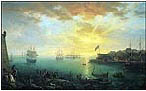 |
|
| Due to a communication failure, La Résolue' and other vessels get seperated from the main body of the armada. Nevertheless, they decide to push on to Mizen Head by the Irish coast. Caught by a heavy storm 'La Résolue' colides with 'Le Redoutable' . She looses al her masts and starts making water. Some of the crew try to seek help with another fregat, but weather conditions are to bad for the main captains gig. They beach at a bay in Ireland and are immidiately capture. 'La Résolue' finaly reaches Brest under jury rig. | 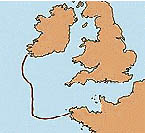 |
|
| The captains gig is later recovered by Richard White, who transfers her to Seafield Park, where she will stay for more than a century and a half. The ship is moved to the National Museum of Dublin in 1944, an gets neglected and disapears into oblivion. The vessel is rediscovered in 1977 by Cyril Chisholm, an architect with a passion. He reconstitutes the building plans of the original yawl down to the last detail, based on the original. It's in 1985 when "Le Chasse-Marée", the largest french magazine on maritime history, is looking for a boat type for that Atlantic Challenge that the class relives. The ship is now called a Yole 1796, or Bantry Bay Yawl , after the bay where the vessel was found, more than 150 years ago. It is the oldest french ship in existence in its original condition. | 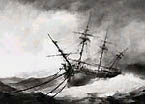 |
|
| In 1997 , "Le
Chasse Marée"decides to launch a challenge: 20
yawls for 2000. In that year, Douarnenez holds another
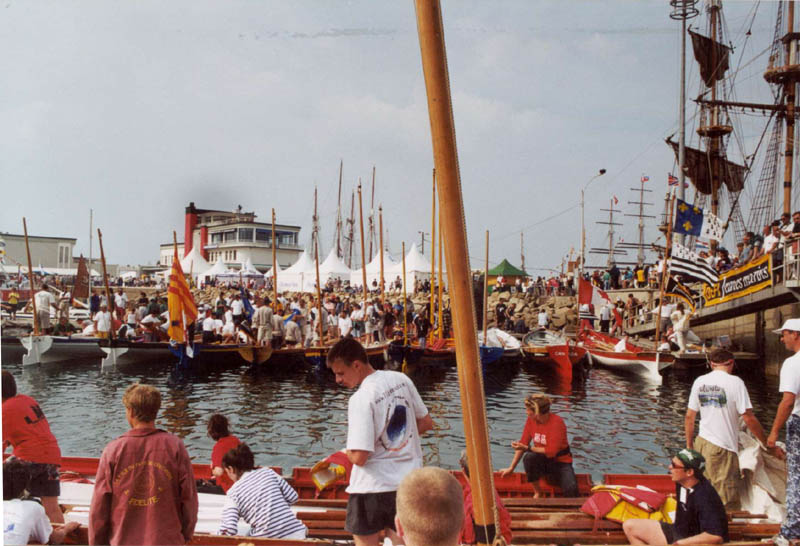
edition of its bi-annual festival of the sea. After attending the Atlantic Challenge in Roskilde (DK) in 1996, Charles Leten was so mesmerized by the design of the boat and the philosophy of the AC, that he couldn't allow the city of Ghent to be absent. The keel was officialy laid up at the Royal Ghent Yacht Club in 1997. For the first time, the inspirator, the builder, the crew, and wat was later to be the ship, were in the same room. In November 1999 the construction started in all earnest. What was considered by many as, at best, a distant dream, turned into reality after 2 years. On july 17th 2000, there were thirty Yawls present in Douarnenez |
 |